Consent Rules for AI Agents in UAE and KSA
If your AI agent touches personal data, check consent _before_ it acts. That is the short answer.
I’d put it this way: the risk is not just the bot. It is the chain behind it. One WhatsApp message, call transcript, or CV can move through 3–6 connected systems in seconds if your workflow links a CRM, email, telephony, HR, and storage tool.
Here’s the article in plain terms:
- UAE: consent is usually the starting point under the PDPL.
- KSA: consent must be separate by purpose, with a clear record and a simple way to withdraw.
- Sales and marketing: get opt-in before first outbound contact, and match it to the channel.
- HR: keep consent separate for screening, scoring, and profiling, and do not let the system act alone on decisions about people.
- Support and monitoring: tell people before recording or analysis starts.
- Records: store the exact wording, date/time, channel, purpose, and status.
- Workflow control: if the system cannot verify consent, _stop the action_.
A few points matter more than the rest:
- One yes is not yes to everything.
- Sensitive data needs a higher bar.
- No record, no action.
Or put another way: if you use AI agents across WhatsApp Business, Microsoft 365, Google Workspace, Odoo, SAP, or Zoho, consent cannot sit in a PDF or a CRM note. It has to sit inside the workflow as a live check.
If you want, I can also turn this into a short LinkedIn post, website intro, or legal-safe landing page copy in the same tone.
The legal baseline: what valid consent looks like in UAE and Saudi Arabia
If your AI agent touches personal data, consent can't be vague. You need a clear record, tied to the exact reason the data is being used. That’s where the day-to-day gap starts between the UAE and Saudi Arabia.
UAE PDPL: consent as the default
Under UAE Federal Decree-Law No. 45 of 2021, consent is usually the starting point for processing personal data before an agent sends, scores, or stores anything.
The controller must record a clear opt-in action and be able to prove it. In plain terms, that means clear affirmative consent. Pre-ticked boxes, implied consent, and terms buried in long text don’t meet the mark.
Saudi PDPL: separate consent by purpose
Saudi Arabia’s Personal Data Protection Law (PDPL) takes a tighter approach on purpose. Consent must be recorded and split by purpose.
For AI agents, that means the record should show the exact purpose and the workflow tied to it. The data subject must also be able to withdraw consent without friction. For sensitive data, explicit consent is mandatory. Sensitive data means a higher bar.
Sensitive data
When sensitive data is involved, the consent record should match the exact sensitive data, the exact purpose, and the exact AI action. It also needs to stay retrievable on request.
Next, apply these rules to sales, HR, support, and internal workflows.
When AI agent workflows need consent, by business function
This gets real fast once you map consent to the workflow itself. Don’t start with the tool. Start with what the agent is doing, whose data it touches, and whether consent must be in place first.
Sales and marketing: outbound WhatsApp, email, calls and lead forms
For outbound WhatsApp, email and calls, get opt-in before first contact. That opt-in should match the channel and the purpose.
One yes does not mean yes to everything. If someone agreed to email updates, that does not automatically cover WhatsApp or phone calls. Keep the wording plain and specific so you can show what the person agreed to, and just as important, what they did not.
HR and recruiting: candidate screening, employee data and AI scoring
HR workflows need separate consent for candidate screening, AI scoring and profiling. These are not small details. They can shape how a person is assessed, shortlisted or treated.
If AI output affects shortlist, progression or treatment, keep a human reviewer in the loop before any decision is acted on. In other words: don’t let the system make the call on its own.
Support and internal operations: call recording, transcripts, QA and monitoring
Recorded calls, transcripts, QA and employee monitoring all sit in consent-sensitive territory. Tell people before recording or analysis starts.
Then record the consent basis and require human review before any material decision. That matters most when monitoring could affect someone’s role, standing or outcome.
| Workflow | Consent question |
|---|---|
| Outbound WhatsApp, email and call campaigns | Collect opt-in before first contact |
| Lead forms for marketing follow-up | Tie consent to the specific channel and purpose |
| Candidate screening and AI scoring and profiling | Record consent separately by purpose; use human review for decisions affecting individuals |
| Recorded calls, transcripts and QA monitoring | Tell people before recording or analysis begins |
| Employee monitoring and profiling | Limit use to the stated purpose |
Once the required consent is clear, the next step is to capture and store it in the channel and workflow record.
How to collect, record and manage consent across channels
Once consent is captured, store it in a format the agent can check before acting.
Consent design for WhatsApp, email, calls and forms
Consent needs to map to each channel. If it doesn't, the agent is guessing. That's where teams get into trouble.
For web forms, use separate, unticked checkboxes for each purpose, with clear wording. Don’t bundle service delivery and marketing follow-up into one consent item.
For email, capture the opt-in at subscription and record the exact wording shown.
For phone calls, use a script that states the purpose and records verbal confirmation before the call continues.
For WhatsApp, keep a record of the specific phone number, the message type and the defined purpose.
Keep service and marketing as separate consent records. When someone withdraws consent, that record must update as well.
What to store in a consent record and how to prove it later
For every consent event, store the fields below.
| Field | What to capture |
|---|---|
| Identity / contact details | Name, email address, phone number or user ID |
| Date/time | DD/MM/YYYY, HH:MM |
| Capture channel | Form, email, call or WhatsApp |
| Exact consent text | The precise wording shown or read at the time |
| Purpose selected | Marketing, service delivery or another defined purpose |
| Status | Active or withdrawn |
| Withdrawal date/time | DD/MM/YYYY, HH:MM |
The exact consent text field matters most. Store the actual wording, not a summary.
If you ever need to prove consent later, this is the field that shows what the person saw or heard at that moment. A paraphrase won’t do the job.
Using workflow software to block action without consent
Don’t treat consent like a box ticked once and forgotten. Build the check into the workflow itself, so the agent blocks any action unless channel-specific and purpose-specific consent is on file.
A workflow layer such as Uklad AI can sit on top of Odoo, SAP, Zoho, Microsoft 365, Google Workspace and WhatsApp Business and block agent actions until the required consent is present.
The agent cannot proceed unless the consent record matches the channel and purpose. In other words: consent becomes a live operational control, not a one-time form submission.
Conclusion: A Practical Consent Checklist for Compliant AI Deployment
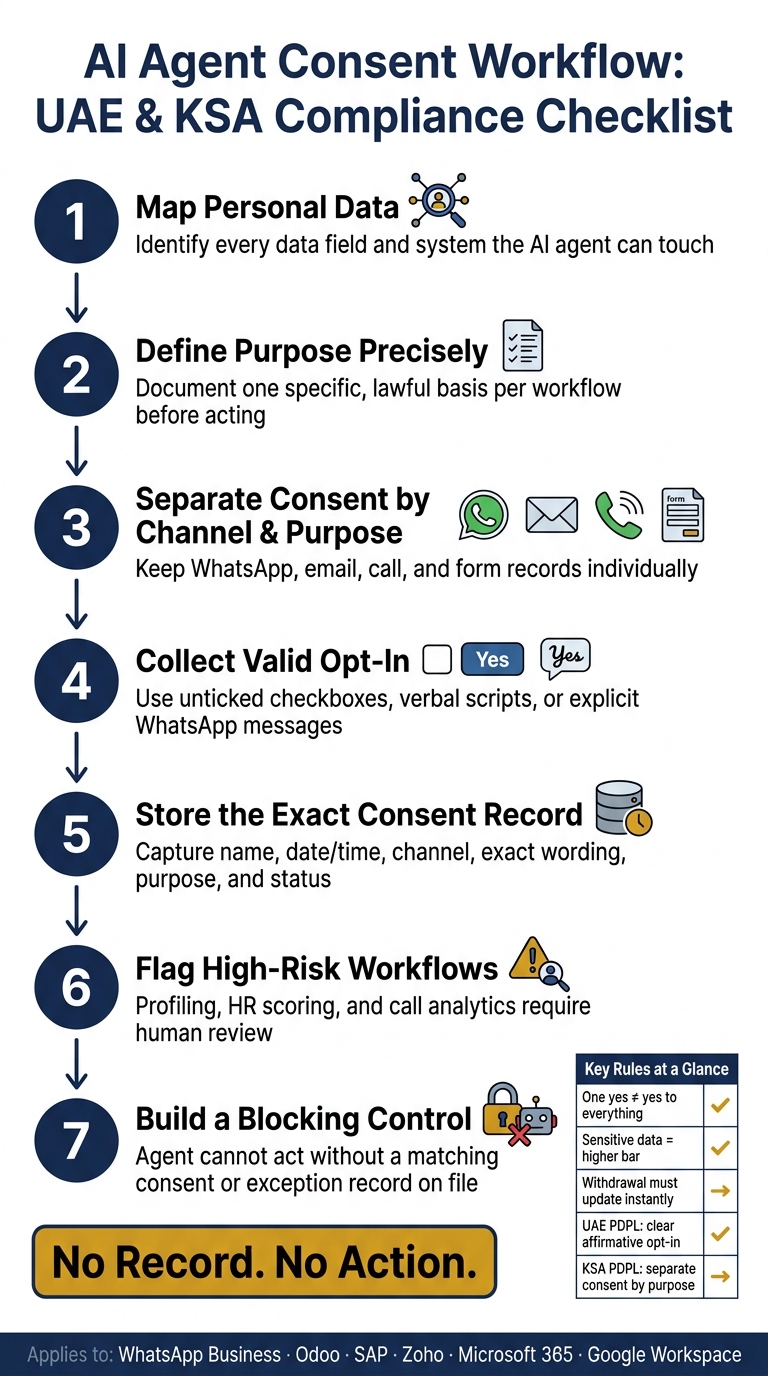
AI projects usually don’t fail at the model layer. They fail in the workflow. If consent sits in a PDF, a CRM note, or someone’s memory, that’s a weak point.
Before any AI workflow goes live, run this checklist. Consent must be checked before an AI agent acts.
Identify the personal data first. Map every personal-data field and every system the agent can touch.
Define the purpose precisely, then check whether consent is required. Document the lawful basis for each workflow. Collect consent only where no exception clearly applies.
Separate consents by channel and purpose. Keep each channel and purpose in a separate record.
Flag higher-risk use cases before deployment. Profiling, automated HR scoring, and call analytics need separate review and tighter controls.
Use this as the final pre-launch gate. The checklist below turns the earlier rules into a launch test.
| Checklist item | What to confirm |
|---|---|
| Data identified | Every data type and system the agent touches is mapped |
| Purpose defined | One specific, documented purpose per consent record |
| Consent or exception confirmed | A valid legal basis is on file before the agent acts |
| Channel-specific records | Separate records for WhatsApp, email, calls and forms |
| Exact consent text stored | The precise wording shown or read, not a summary |
| Withdrawal mechanism live | The person can withdraw, and the record updates immediately |
| High-risk workflows reviewed | Profiling, HR scoring and call analytics assessed separately |
Build these checks into the workflow as a blocking control: the agent cannot act without a matching consent or exception record.
Or put another way: no record, no action.
Make consent an enforced workflow control. If the workflow cannot verify consent, stop the launch.
FAQs
When is consent not enough on its own?
The gap here is simple: the available sources don’t say when consent stops being enough on its own for AI agent workflows in the UAE or KSA.
They also don’t set out the legal or process limits of consent in this setting. So, based on those sources alone, this question can’t be answered.
Or put another way: if you need a clear view on where consent works, where it falls short, and what extra controls may be needed, the source set does not give that detail.
Can one consent cover several AI actions?
There is no reliable answer in the material at hand.
The search results provided do not say whether, in the UAE or Saudi Arabia, one consent can cover multiple AI agent actions.
What should we do if consent is missing or withdrawn?
The gap here is simple: the sources do not cover this.
They do not include details on UAE or KSA AI-agent consent workflows. They also do not explain what to do if consent is missing or withdrawn.
So, based on the material provided, this question cannot be answered from the given sources.