AI Delivery Tracking in Gulf Vendor Coordination
Most late deliveries are not a planning failure. They are a follow-up failure.
If I need one clean way to track supplier commitments across the UAE and KSA, I would keep it simple:
- ERP stays the record
- AI agents chase routine updates
- People handle disputes and high-risk cases
- WhatsApp, email, and calls feed one view
- UAE and KSA data rules are set before rollout
This only works if I track a small control set from day one: on-time delivery, delivery variance, quantity accuracy, supplier response time, and issue resolution time.
Or put another way: if a supplier changes an ETA on WhatsApp, confirms a partial shipment by email, and explains a border hold on a call, I need _one current record_, not three half-records.
A pilot should stay tight and measurable. I would start with one supplier group, one lane, or one shipment type, then judge it on numbers such as:
- OTIF: above 90% for SMBs, above 95% for enterprise
- Supplier response time: under 2 hours
- Inbound status queries: down 40%–60%
- Manual reconciliation time: down 30%–50%
- Exception resolution time: under 4 hours
A few points matter most:
- WhatsApp Business is strong for day-to-day updates in the GCC, with open rates often reported at 92%–98%
- Email still fits formal confirmations and revised terms
- Calls fit escalations, with transcription written back to the same record
- Audit logs, RBAC, tokenisation, and in-region hosting should be set before any rollout
- Every AI action should write back to ERP with a timestamp and reason
Here, the value is not one bot. The value is a workflow where routine chasing happens on time, in Arabic and English, without pushing staff into manual re-entry.
If you are testing this in a live procurement setup, I would not start with a full rollout. I would start with a 30-60-90 day pilot, prove one workflow, and then decide what to expand.
How to Analyze Supplier Lead Times & PO Receipts with AI (Grok Demo + Prompts)
How AI improves delivery commitment tracking
Late updates usually aren’t a planning problem. They’re a follow-up problem.
AI agents keep delivery metrics current by taking care of routine follow-up between human touchpoints. Use the five baseline metrics as triggers for reminders, escalation, and ETA refreshes.
AI handles routine follow-up; people handle escalations
Split the work by judgement. AI agents fit into business workflows by taking the high-volume, low-risk tasks: sending status-check messages before a due date, asking for a revised ETA when updates stop, logging supplier replies back into the ERP, and flagging orders that are trending late. People stay on the work that needs judgement: resolving disputes, managing a supplier relationship after repeated failures, or deciding whether to switch vendors entirely.
AI drafts follow-ups and flags risk. Managers approve escalations and supplier-critical decisions. That means follow-up can scale without adding headcount, and updates don’t get lost across channels.
One shift here matters a lot: communication moves from reactive to proactive. Instead of waiting for a warehouse manager to spot a late shipment, an AI agent picks up the delay signal from carrier APIs or a TMS update and sends an alert with a new ETA [2]. Research from logistics AI deployments in the region shows that proactive delay notifications reduce inbound status enquiries by a clear margin [2].
Bilingual and cross-channel coordination across WhatsApp, email, and calls
AI should read Arabic and English updates, including voice notes, and write them into one delivery record. A corporate AI layer can sit on top of the ERP or CRM already in use and pull together WhatsApp Business, email, and calls into a single record.
The table below shows how each channel compares for procurement follow-up, and where AI automation adds the most value.
| Channel | Speed | Formality | Auditability | Language Handling | AI Suitability |
|---|---|---|---|---|---|
| WhatsApp Business | Instant | Low / conversational | High - full chat logs | Excellent - dialects and voice notes | High - automated flows and status bots |
| Asynchronous | High / structured | High - threaded history | Good - standard Arabic and English | Medium - drafting and document extraction | |
| Voice / Calls | Real-time | Medium | Medium - requires transcription | High with dialect-aware NLP | Medium - emerging, best for escalations |
WhatsApp Business API delivers 92–98% open rates for logistics communication in the GCC [1], which makes it a strong fit for logistics updates. Email is still the right channel for formal confirmations, revised PO terms, and anything that needs a documented paper trail. Voice works best for escalations, where tone and negotiation matter, and where AI transcription can capture the outcome for the record.
That unified record is what operations should sync into ERP next.
UAE and KSA data residency, compliance, and system design
If AI is going anywhere near vendor workflows, sort the data first. Vendor, shipment, location, and message data do not all carry the same risk. Some of it is personal. Some is operational. Some may sit under local rules. Put each type in the right bucket, then decide what stays local and what can pass through AI.
What to check before sending vendor data through AI workflows
Both the UAE and Saudi Arabia have enacted Personal Data Protection Laws (PDPL) that govern how personal data, including delivery addresses and phone numbers, is stored and processed. For KSA operations, the National Cybersecurity Authority (NCA) sets extra standards for audit logging and access control.
Fixing residency, consent logging, and audit trail gaps _after_ deployment is painful and expensive. It is far easier to make those calls at the design stage.
The table below is a practical starting point for classifying the data your delivery tracking workflows will touch.
| Data Category | Keep in-region? | Key Regulation |
|---|---|---|
| Customer PII (name, address) | Yes - UAE/KSA | UAE/KSA PDPL |
| ZATCA e-invoicing data | Yes - KSA only | ZATCA Phase 2 |
| Supplier rate cards | Internal use only | Internal governance |
| Driver GPS/telematics | Yes - preferred | NCA Standards |
| Communication logs (WhatsApp, email) | Yes - UAE/KSA | PDPL / CITC |
Once each data type is classified, you can design the workflow around approved residency and logging rules.
- Tokenise sensitive fields such as supplier identifiers, customer addresses, and phone numbers before they pass through any outbound AI model.
- Verify hosting location. UAE-region infrastructure or KSA sovereign cloud setups help keep data inside the right jurisdiction.
- Use role-based access control (RBAC) so only the right people can view a given vendor record.
- Log every AI action such as status updates sent, follow-ups triggered, and ERP records changed in a complete, exportable audit trail.
Using a corporate AI layer over existing systems
That same governance model should shape the AI orchestration layer.
A corporate AI layer sits between vendor channels and system records. Its job is simple: handle follow-ups, log replies, and sync updates without copying sensitive records into places you do not control. Uklad AI is built for this setup, with regional data residency for the UAE and KSA and integration across Odoo, SAP, Zoho, Microsoft 365, Google Workspace, and WhatsApp Business.
Every AI action should write back to the ERP record with a clear timestamp and reason. In other words: every status check, reply, and exception should flow back into ERP, not sit in a side tool where no one can trace it.
ERP integration and the operating workflow
After you’ve sorted data residency and governance, the next issue is simple: where does delivery data live, and who keeps it current? The ERP should stay the system of record. Each commitment should map to one record, and the AI layer should update that record from every channel.
Mapping promised and actual delivery data into ERP records
Every delivery commitment needs one clear home in your ERP, whether that’s Odoo, SAP, or Zoho. Only compliant fields should move into the ERP record. Sensitive data stays under the residency model you’ve already set. The core fields are not complicated.
| Field | Local Format Example (en-AE) |
|---|---|
| PO Number | PO-2026-0910 |
| Supplier Name | Gulf Vendor Solutions LLC |
| Promised Date | 10 September 2026 |
| Revised ETA | 12 September 2026 |
| Actual Receipt Date | 12 September 2026 |
| Quantity Received | 5,000 Units |
| Issue Code | LATE-LOG (Logistics Delay) |
| Total Value | AED 25,000.00 |
| Owner | Named procurement contact accountable for resolution |
Issue code matters more than it looks. It separates customs delays from production delays, so teams can send the issue to the right person without wasting time. Shipment references, tracking IDs, Incoterms, and freight invoices should sit alongside the same delivery record.
When warehouse teams scan receipts, the ERP should update the actual receipt date and quantity received on its own. No second round of manual entry. No copying details from one screen to another.
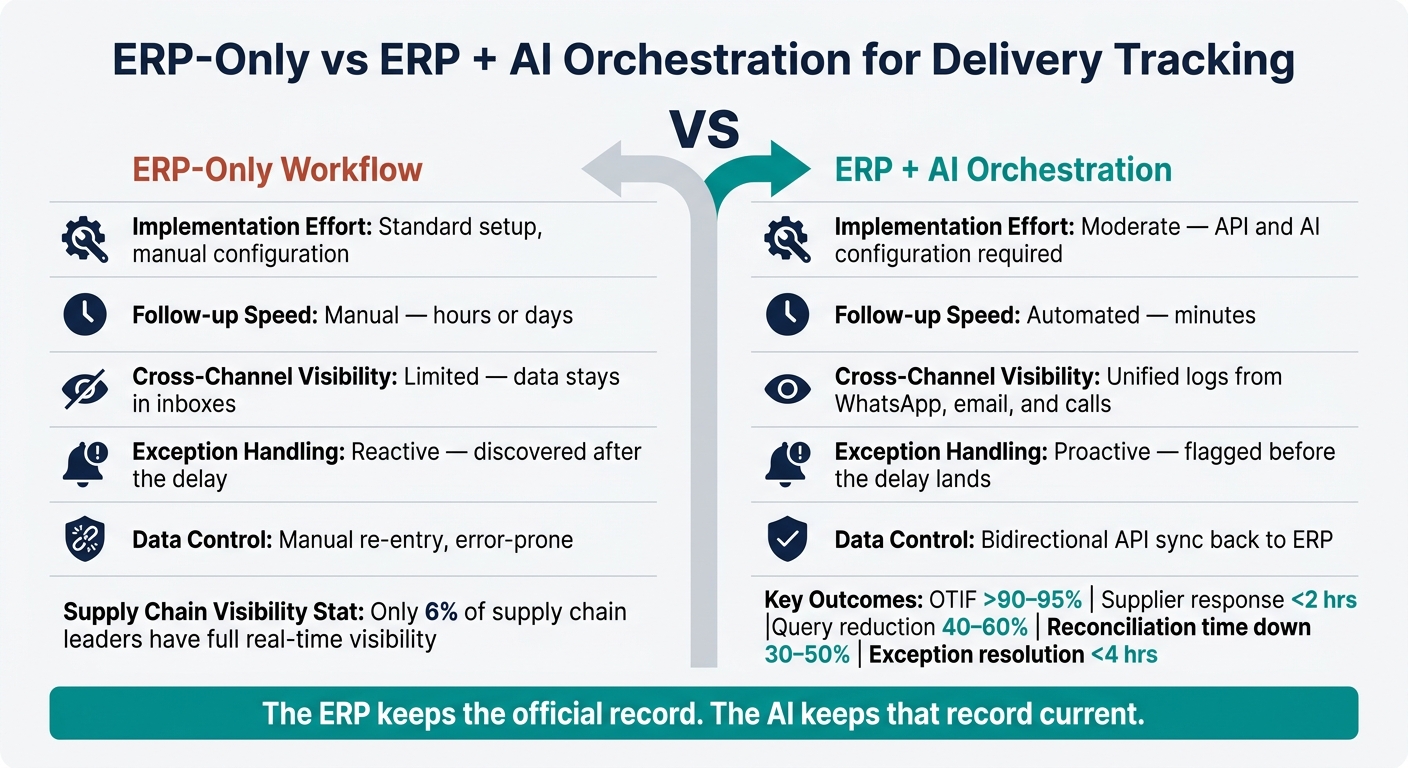
ERP-only workflow versus ERP plus AI orchestration
This is where the day-to-day work changes. In an ERP-only setup, teams spend time chasing updates. In an ERP-plus-AI setup, they spend time dealing with exceptions.
With ERP only, procurement staff often spend hours sending emails or WhatsApp messages, waiting for replies, then typing those updates back into the system. That’s slow, and parts of the story stay buried in inboxes. Only around 6% of supply chain leaders report having full, real-time visibility across their end-to-end supply chain [4].
Add an AI orchestration layer, and the model shifts. The AI watches open PO lines, sends follow-ups through WhatsApp Business and email in both Arabic and English, pulls revised ETAs from replies, and writes them back into the ERP record. Staff step in only when the system flags a real exception, like a supplier refusing a date, a short shipment, or a delay that needs escalation.
| Feature | ERP-Only Workflow | ERP + AI Orchestration |
|---|---|---|
| Implementation Effort | Standard setup, manual configuration | Moderate - API and AI configuration required |
| Follow-up Speed | Manual, hours or days | Automated, minutes |
| Cross-Channel Visibility | Limited - data stays in inboxes | Unified logs from WhatsApp, email, and calls |
| Exception Handling | Reactive - discovered after the delay | Proactive - flagged before the delay lands |
| Data Control | Manual re-entry, error-prone | Bidirectional API sync back to ERP |
Or put another way: the ERP keeps the official record, while the AI handles the messy middle part of supplier communication.
Uklad AI can sit on top of your current ERP as that orchestration layer. It manages follow-up timing, processes replies in Arabic and English, and writes each status update back to the ERP record with a timestamp. The ERP stays the source of truth. The AI layer keeps that truth current.
Once that workflow is set, the next job is ownership: who approves exceptions, who reviews alerts, and what should be automated first.
Adoption, governance, and next steps
AI delivery tracking usually fails for a simple reason: teams treat it like a tool rollout, not a workflow change.
The setup matters, yes. But what makes it work is clear ownership, a tight rollout plan, and a small set of metrics that show if the process is doing its job.
A 30-60-90 day rollout for procurement and operations teams
Start small. Pick one vendor group or one delivery lane, not the full network.
That gives procurement and operations room to test the workflow, fix rough edges, and show value without dragging the whole business into a messy launch.
Days 1–30: Scope and prepare. Audit ERP, TMS, and WMS sources and confirm they feed one shared record. Map your data residency obligations under UAE PDPL and KSA data-residency and governance rules before any vendor data moves through an AI workflow [3]. Identify one high-frequency, bounded problem - for example, shipment follow-up for a single supplier category - and set a baseline for the KPIs you plan to improve.
Once the data and access rules are clear, connect the channels.
Days 31–60: Connect and configure. Build the API connections between your AI orchestration layer and your ERP (Odoo, SAP, or Zoho). Standardise Arabic and English templates for WhatsApp Business and email. Define your escalation rules clearly: set a named procurement contact for supplier disputes, short shipments, or anything above a set value threshold. Set up role-based access so finance, operations, and procurement each see only what they need. Confirm that audit logs capture every AI action with a timestamp, exportable for compliance or dispute resolution.
Days 61–90: Pilot, measure, and decide. Run the system with a limited group of staff and vendors. Review performance against your baseline KPIs and refine escalation thresholds based on what actually gets flagged. A focused 2–4 week pilot is enough to prove one workflow before expanding. Resolve any data-quality issues before scaling.
KPI table and final takeaways
Use these metrics to judge whether the pilot should expand.
| KPI | Primary Data Source | Target Range |
|---|---|---|
| On-Time In-Full (OTIF) Rate | ERP / TMS | SMB: >90% / Enterprise: >95% |
| Supplier Response Time | AI Orchestration Logs | Under 2 hours (automated follow-up) |
| Inbound Query Reduction | AI Logs / WhatsApp API | 40%–60% reduction |
| Manual Reconciliation Hours | Finance / ERP Logs | 30%–50% reduction |
| Exception Resolution Time | TMS / AI Dashboard | Under 4 hours |
| Straight-Through Processing (STP) | AI Logs / ERP | SMB: 50%–70% / Enterprise: 80%+ |
Keep the operating model simple.
- ERP stays the system of record
- AI handles routine follow-up across WhatsApp, email, and calls in Arabic and English
- People handle exceptions: high-value approvals, supplier disputes, and judgment calls
- Vendor data stays within UAE and KSA residency rules throughout
That split is where most teams get it right. The bot does the repetitive chasing. Your people step in where context, risk, or supplier judgment matter most.
FAQs
How does AI keep ERP delivery records current?
AI keeps ERP delivery records current through bidirectional API integrations, with the ERP acting as the single source of truth. That matters because manual status updates tend to fall apart under daily pressure.
Instead of relying on someone to chase updates, changes in logistics platforms, GPS feeds, or carrier APIs can push straight into the ERP. When a delivery status changes, gets delayed, or hits a milestone, the ERP updates on its own.
For organisations in the UAE and KSA, there’s another layer to get right: data residency. These integrations need to keep operational and personal data in local cloud regions where required, so teams can stay in line with local rules without breaking the workflow.
What data must stay in-region in the UAE and KSA?
In the UAE and KSA, where your data sits matters. Sensitive customer and shipment data must remain inside the country or in an approved sovereign cloud setup.
That covers personal data under laws such as the UAE’s PDPL. In practice, this means strict access controls, data minimisation, and audit trails that show who accessed what, and when.
The same rule applies to day-to-day operational records. Customs information, commercial invoices, and shipment documents need to be handled in line with national cyber rules, including those set by Saudi Arabia’s NCA.
How should I start a 30-60-90 day pilot?
Start in three stages:
- Days 1–30: Audit ERP and carrier data. Pin down pain points and KPIs. Map data access. Confirm UAE and KSA data residency needs.
- Days 31–60: Run a pilot in one region or one warehouse. Connect ERP/TMS to the AI communication layer. Turn on Arabic and English updates.
- Days 61–90: Measure results. Fix integration issues. Plan the phased scale-up.
By day 90, the team should shift from manual entry to exception management, while routine tracking updates run automatically.