Why Hiring Managers Delay Feedback and AI Fixes It
Slow hiring feedback is usually a workflow fault, not a motivation fault. If interview notes sit across email, WhatsApp Business, calendars, and the ATS, your team loses time in handoffs, candidates wait, and open roles stay open longer.
Here’s the short version:
- The delay often starts after handoff points like shortlist review, interview scorecards, and final approvals.
- Managers are not always the core issue. The bigger issue is scattered tools, weak ownership, and no clear due date.
- AI agents help by handling the chasing work: reminders, deadline tracking, draft summaries, and pre-filled scorecards.
- The main test is time. Track:
- Average time to shortlist review
- Post-interview feedback turnaround
- Time to final decision
- Candidate drop-off after interviews
- Vacancy cost, if your finance team already tracks it in AED
Or put another way: if you want faster hiring, stop relying on manual follow-up alone. Put the workflow in one place, make ownership clear, and cut the effort needed from hiring managers.
A few points matter most:
- Candidates feel delay fast. Research often shows many job seekers lose interest when hiring drags, and drop-off climbs when communication slows.
- Recruiters lose hours to chasing updates instead of moving roles forward.
- Leadership loses visibility when status sits in separate inboxes and chat threads.
What I’d focus on first:
- Set a baseline from your last 30–90 days of hiring data.
- Find the slowest handoff in the process.
- Add AI-led reminders and draft scorecards there first.
- Compare before-and-after response times.
| Checkpoint | Manual process | AI-supported process |
|---|---|---|
| Feedback requests | Sent and chased by recruiter | Sent on time with due dates |
| Scorecards | Started from blank | Drafted from notes for review |
| Missed follow-ups | Hard to spot | Overdue items flagged |
| Status view | Spread across tools | Seen in one workflow layer |
The point is simple: better hiring speed comes from better workflow design. If you want to test that in your own setup, the next step is a small pilot on one role family or one business unit, then measure the change.
Build a Full AI Hiring System in Make.com (Resume to Voice Interview)
sbb-itb-c83bf24
Why Hiring Managers Delay Feedback
One common cause is fragmented tools.
Scattered Tools Make Feedback Easy to Miss
When feedback moves through too many channels, managers miss it. If interview notes are split across email, WhatsApp Business, and HR systems, feedback requests slip through the cracks. No one has a clear owner. No one sees a clear deadline.
That’s how a simple follow-up turns into a stalled hiring decision.
How AI Agents Cut the Main Feedback Delays
Hiring feedback usually slows down for boring reasons: missed messages, fuzzy ownership, and tools that don’t talk to each other. AI agents can sit on top of the systems teams already use and take care of the coordination work that drags the process out.
Automated Reminders and Deadline Tracking Keep Decisions Moving
AI agents send structured prompts, add due dates, and flag overdue items so recruiters can see what’s still pending at a glance. That keeps each hiring step visible and cuts out the manual chasing that eats up recruiter time.
Interview Summaries and Draft Scorecards Reduce Manager Effort
Reminders help, but they’re only part of the fix. Managers also need the feedback task itself to feel lighter.
AI agents turn call notes and meeting notes into short, structured summaries. The manager gets a pre-filled scorecard, then reviews it, edits what needs changing, and approves it. That’s a lot easier than starting from a blank form, so responses tend to come in sooner.
A Central AI Layer Connects Messages, Approvals, and Records
The same pattern works across the full hiring workflow. A central AI layer links feedback requests, interview notes, and approvals across the tools already in use, so decisions move through one coordinated layer instead of getting stuck across disconnected inboxes.
How to Measure Whether AI Is Actually Speeding Up Hiring Feedback
A coordination layer sounds good on paper. The only thing that matters is whether it cuts feedback time in practice.
Once AI is handling hiring coordination, track whether feedback is moving faster. If you don’t set a baseline first, you’re guessing.
Track Response Times, Drop-Off Rates, and Vacancy Cost
Start with a small group of numbers that HR, operations, and finance can all read without a long explanation.
Average time to shortlist review shows how long a hiring manager takes to respond after a recruiter sends candidates. Post-interview feedback turnaround tracks the gap between the end of an interview and a scored response in the system. Time to final decision covers the full path from first interview to offer or rejection. Candidate drop-off after interviews shows how many applicants stop replying, which can point to slow feedback pushing them away.
If finance already tracks vacancy cost, add that as well. It makes the cost of delay plain to the business.
Set the baseline before any AI rollout. Pull recent timestamps from your ATS, email, and calendar logs. Note the date and time for each stage. Then calculate the average response times.
Manual Workflow Versus AI-Orchestrated Workflow: A Direct Comparison
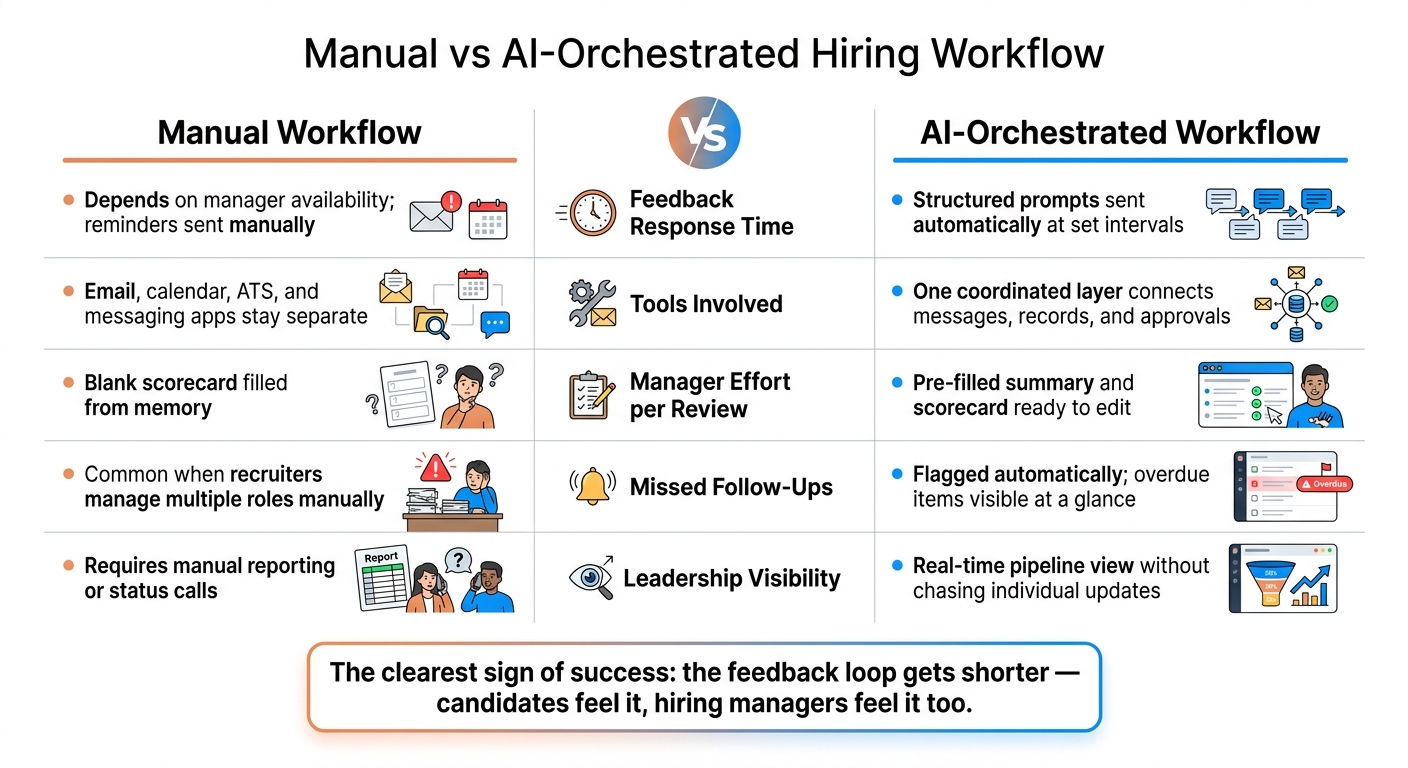
Use that baseline to compare manual coordination with an AI-orchestrated workflow. The table below shows what usually changes when a central AI layer takes over coordination.
| Factor | Manual Workflow | AI-Orchestrated Workflow |
|---|---|---|
| Feedback response time | Depends on manager response time; reminders are manual | Structured prompts sent automatically at set intervals |
| Tools involved | Email, calendar, ATS, and messaging apps stay separate | One coordinated layer connects messages, records, and approvals |
| Manager effort per review | Blank scorecard filled from memory | Pre-filled summary and scorecard ready to edit |
| Missed follow-ups | Common when recruiters manage multiple roles manually | Flagged automatically; overdue items visible at a glance |
| Leadership visibility | Requires manual reporting or status calls | Real-time pipeline view without chasing individual updates |
The clearest sign is simple: the feedback loop gets shorter. Candidates feel it. Hiring managers feel it too.
If post-interview turnaround improves and candidate drop-off starts to fall, the workflow redesign is doing its job.
For UAE and KSA deployments, confirm where candidate data is stored. Uklad AI supports regional data residency on request.
Conclusion: Faster Feedback Comes from Better Workflow Design, Not More Chasing
If feedback is still slow, the problem sits in the workflow. It’s not about whether the hiring manager cares. It’s about how the work moves, where it gets stuck, and what happens after the interview.
AI cuts that friction by sending timed prompts, preparing draft scorecards, and adding a central workflow layer that keeps decisions moving. That’s what clears the delay.
AI agents can sit on top of Microsoft 365, Google Workspace, WhatsApp Business, Odoo, SAP, or Zoho, so teams can keep working in the tools they already use.
The result is faster post-interview turnaround times and less chasing.
FAQs
What usually causes feedback delays?
Feedback delays in hiring usually come down to a few plain problems:
- Missed messages
- Unclear ownership in the hiring process
- Scattered tools that make communication harder
The result is simple: responses slow down, and follow-up becomes less consistent.
How does AI speed up hiring feedback?
AI speeds up hiring feedback by handling the slow parts: logging and organising candidate messages, creating structured interview summaries, drafting timely updates, and tracking owners and deadlines.
It also cuts delays caused by scattered tools by bringing context into one place, so hiring managers can reply faster without digging through different channels.
How can we measure if it works?
Track the average time from request submission to the final hiring manager decision. If that time drops, your process is moving faster.
You can also watch missed or pending messages in tools such as Microsoft 365 or Google Workspace. That shows whether automated reminders are actually closing communication gaps, not just adding more noise.
Uklad can sit on top of these tools to streamline communication and support monitoring inside UAE business workflows.