How AI Teams Win Stakeholder Buy-In
Stakeholder buy-in starts with a measured workflow result, not an AI promise. A 6–8 week pilot should test one workflow against recorded time, cost and error rates, with named owners and agreed rules to stop, refine or scale.
Before launch, teams need to:
- Agree the business case: involve sponsors, IT and users; separate freed staff time from cash savings.
- Set approval limits: start with read-only access where possible, require human approval for high-impact actions and check UAE and KSA data rules.
- Prepare users: train each role, appoint internal champions and provide English and Arabic support.
- Review results weekly: assess value, usage and safety, then expand team by team only when results, controls and user readiness support it.
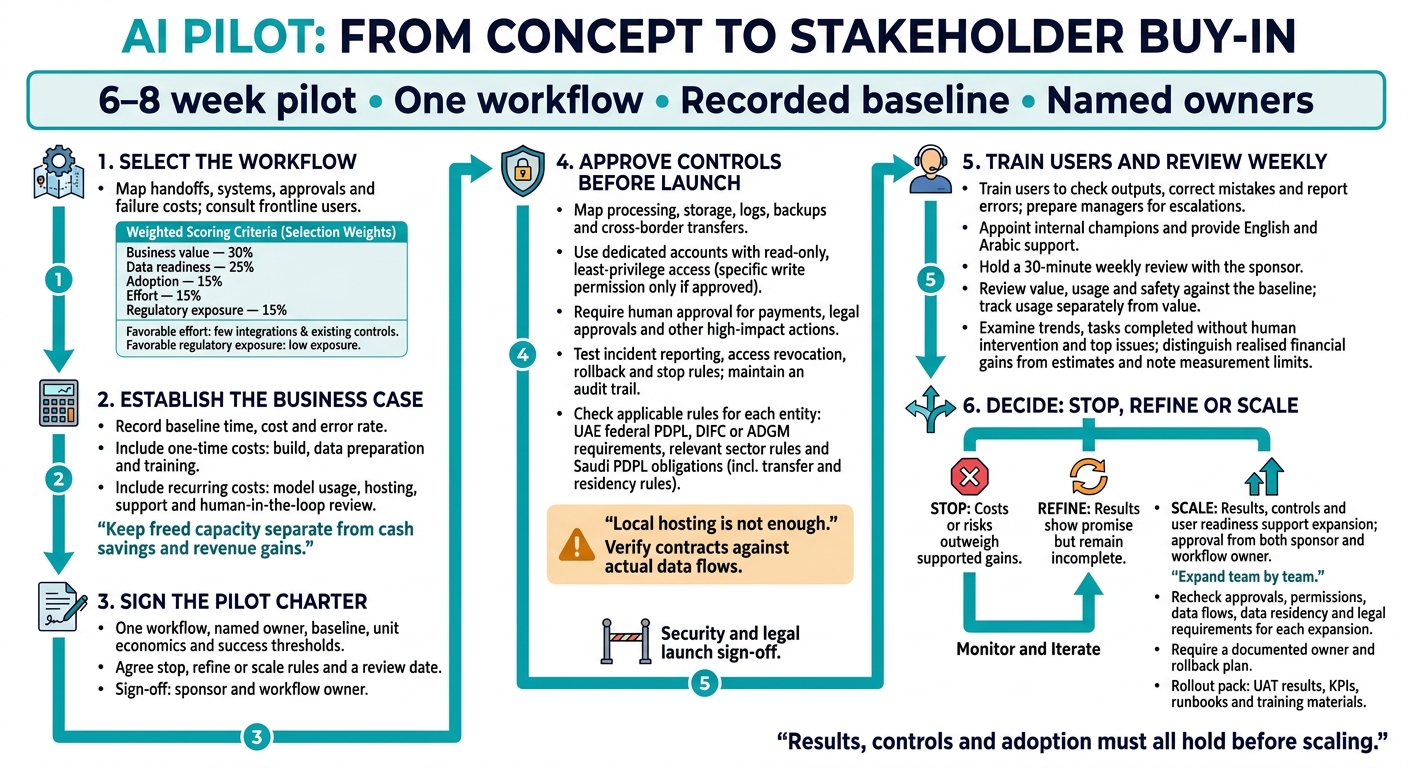
Build the Business Case and Set Pilot Scope
Map the Workflow and Stakeholder Needs
Start with a workflow problem stakeholders already face. Map its handoffs, systems, approvals and failure costs, then ask frontline users where delays and rework happen.
Rank candidate workflows using a weighted scoring model covering business value, data readiness, adoption, effort and regulatory exposure.[4]
| Criterion | Weight | What a high score looks like |
|---|---|---|
| Business value | 30% | Measurable business gain |
| Data readiness | 25% | Data ready for use |
| Adoption | 15% | Clear user demand |
| Effort | 15% | Few integrations, existing controls |
| Regulatory exposure | 15% | Low regulatory exposure |
Map stakeholder needs across ownership, handoffs, integrations, compliance, training and review duties. Bring IT and security into the design process as partners.[1][2]
Use the highest-ranked workflow to establish the baseline and build the ROI case.
Calculate ROI From a Recorded Baseline
Record time, cost and error rate during the baseline period.[5] Build the business case around unit economics, accounting for one-time costs such as build, data preparation and training, plus recurring costs such as model usage, hosting, support and human-in-the-loop review.[3][4][5]
Keep freed capacity separate from cash savings and revenue gains so the pilot does not overstate its return.[3] These figures give sponsors a clear basis for approval.
Use the numbers to agree the pilot scope in a signed charter.
Approve a Single-Workflow Pilot Charter
Have the sponsor and workflow owner sign a charter covering one workflow. Record the workflow changes, named owner, baseline, unit economics and success thresholds.
Include the decision rule for stopping, changing or extending the pilot, along with the review date.[5]
LLMs, Gen AI and Stakeholder Buy-in
Set Data and Governance Controls Before Launch
Turn the approved pilot into a security and legal launch sign-off. Assign each agent a business owner and approval limits. Document who can approve changes, handle incidents and stop the agent. Once these controls are signed off, move to user training and a monitored launch.
This gives stakeholders written controls to approve against their risk concerns.
Document Data Flows and Access Controls
Map how data moves from connected systems through processing, storage, logs and backups. Record subprocessors, processing locations, access to prompts and logs, use of data for training, retention, deletion and cross-border transfers.
Use dedicated service accounts with read-only, least-privilege access unless a specific write permission has been approved.
Maintain a central audit log of inputs, outputs, timestamps and the decision trail. Require human approval for payments, legal approvals and other high-impact actions. Before launch, test incident reporting, access revocation, rollback and stop rules.
Check UAE and KSA Rules for Each Entity
Map compliance requirements for each legal entity before launch, since approvals differ. Check UAE federal PDPL, DIFC or ADGM requirements, relevant sector rules and Saudi PDPL obligations, including transfer and residency rules.
Local hosting is not enough. Verify contracts against actual data flows, including support access, logs and backups.
Use these records to address stakeholders’ specific objections. Attach them to the approval pack so stakeholders sign off on controls, not assurances.
| Stakeholder concern | Required record | Approval owner | Control |
|---|---|---|---|
| Unauthorised access | Data map and access controls | Security | Dedicated accounts; least privilege |
| Privacy and overseas processing | Applicable-law review, contracts and transfer assessment | Legal/privacy | Verified processing locations, retention and deletion |
| Unsafe actions | Test results and approval limits | Business owner | Human review for high-impact actions |
| Failure or loss of control | Incident, rollback and fallback test records | Security and operations | Stop rules, access revocation and manual fallback |
Train Users, Review Results and Roll Out in Phases
After launch sign-off, move to supervised use, not another presentation. Keep the executive sponsor accountable for adoption, risk and results.[5]
Train Each Role and Appoint Internal Champions
Train users on actual workflow tasks: checking outputs, correcting mistakes and reporting errors. Make clear which actions they can approve, escalate or reject. Managers should practise handling escalations.
Appoint respected pilot users as internal champions, with protected time for demonstrations and issue triage. Explain changes to daily roles and admin tasks, and provide support in English and Arabic.
Once users can run the workflow, start weekly measurement.
Review Value, Usage and Safety
Hold a 30-minute weekly review with the sponsor to assess performance trends, tasks completed without human intervention and top issues.[1] Compare results with the recorded baseline. Track usage separately from value, and investigate low usage before assuming resistance.
Separate realised financial gains from estimates. Note measurement limits, such as incomplete records or changes in case complexity, and apply the agreed stop, refine or scale thresholds.[5]
Approve Expansion Team by Team
Use weekly reviews, UAT results and KPI trends to decide whether the pilot is ready for the next team. Expand team by team before extending across UAE and KSA entities.
For each expansion, recheck approvals, permissions, data flows, data residency and legal requirements. Require a documented owner and rollback plan. Give the sponsor a rollout pack containing UAT results, KPIs, runbooks and training materials.[2]
Conclusion: Use Pilot Results to Decide What Comes Next
Use the pilot record to assess value, controls and readiness before approving expansion, team by team, across the UAE and KSA.
Stop if costs or risks outweigh supported gains. Refine if results show promise but remain incomplete. Scale only with approval from both the sponsor and workflow owner.[5] Results, controls and adoption must all hold before scaling.
FAQs
How can we prove AI value without cutting headcount?
Position AI as support for repetitive, rule-based tasks, not a replacement for staff. Base the business case on freed-up staff capacity, avoided recruitment, reduced overtime or cleared backlogs.
Before the pilot, record baseline measures: cost per transaction in AED, time per case or error rate. Track changes during the pilot and report business outcomes, not usage counts or prompt volume. Show how existing staff can handle more work or focus on higher-value tasks.
How do we address staff fears about AI replacing jobs?
Position AI as support for repetitive, manual work, not a way to cut headcount. Show staff where it fits into daily tasks in Microsoft 365, Google Workspace or SAP, with people retaining oversight and the authority to make decisions.
Bring sceptics into training and feedback sessions to identify where work gets stuck. Demonstrate tasks such as drafting documents or managing lead follow-ups, and make human review visible so the focus stays on support rather than displacement.
Can UAE and KSA teams share one AI pilot?
UAE and KSA teams can share an AI pilot and resources, but local data residency and regulatory requirements must shape the design. These include the UAE PDPL and Saudi frameworks.
Appoint local champions at each site to handle training, escalation and policy reinforcement. Keep support close to the work, with help for mixed-language inputs and regional document standards.