AI Security in the Enterprise: Common Questions Answered
If an AI agent can read, decide, and act inside your systems, treat it like a high-risk user before you put it live.
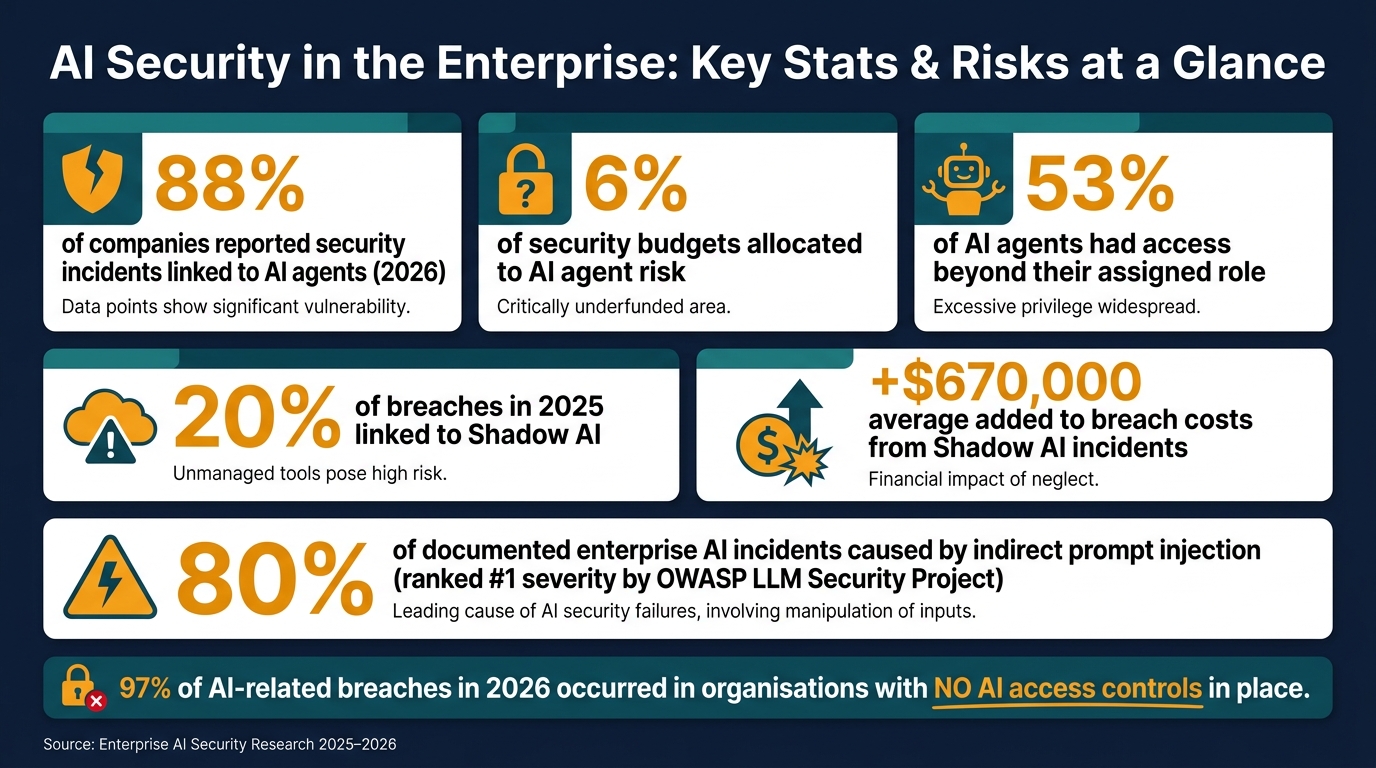
I’d boil the article down to this: most AI risk in the enterprise is not about the model alone. It comes from too much access, unsafe integrations, poor vendor controls, staff using unapproved tools, and weak audit trails. In 2026, 88% of companies reported security incidents linked to AI agents, while only 6% of security budgets were set aside for that risk. On top of that, 53% said their agents had access beyond their job.
If you’re planning a rollout in the UAE or Gulf, I’d check five things first:
- Data location: where data is stored, processed, and whether UAE residency is available
- Agent identity: one named identity, one owner, no shared accounts
- Access scope: task-level permissions, not full system access
- Human approval: keep people in front of money movement, record deletion, IAM changes, and external messages
- Logs and shutdown: full action logs and a kill switch that cuts access at once
A few points stand out.
- Prompt injection is one of the top risks for deployed language models, and the more dangerous indirect form made up 80% of documented enterprise AI incidents cited in the article.
- Shadow AI is a staff problem as much as a security problem. In 2025, it was linked to 20% of breaches and added USD 670,000 on average to breach costs.
- For UAE firms, data residency and sovereignty need direct answers before rollout, especially in DIFC, ADGM, healthcare, finance, and government use cases.
- A safer starting point is a read-only pilot in monitor mode, then human-approved mode before any agent gets permission to act.
Or put another way: don’t judge an AI deployment by how well the demo works. Judge it by _what it can access_, _what it can change_, and _how fast you can stop it_.
For most teams, the right first step is not a broad launch. It’s a small pilot with tight permissions, masked data, vendor checks, and logs you can review after each action. In the UAE, the article puts a proof-of-concept pilot at around USD 15,000 to USD 40,000 over 4 to 6 weeks.
If I were using this article to make a go-live call, my test would be simple: can we prove control over data, access, actions, vendors, and staff use before production? If the answer is no, the rollout is early.
How to Secure the Agentic Enterprise: AI Workflow Security Guide
The Main AI Security Risks in Business Systems
The risk shows up the moment AI touches live systems. At that point, the main problems are access creep, prompt attacks, and data exposure. Things get messier when agents plug into CRM, ERP, email, and messaging tools.
Data Leakage, Unauthorised Access, and Model Misuse
When teams set up an AI agent in a rush, they often give it far more access than it needs. Maybe it gets a shared API key. Maybe it gets full mailbox access just to get the job done fast. On paper, that sounds convenient. In practice, it means the agent might read HR files, edit CRM records, or pull financial data from an ERP system when its job is much narrower.
That’s why least-privilege access isn’t optional. It’s the baseline.
There’s another weak spot here: shadow AI. Teams often connect browser extensions, productivity bots, and summarisation tools to company systems without IT knowing. Those tools may send company data to external AI services with no audit trail and no compliance review [5]. As Fabio Lauria, CEO of ELECTE, put it:
"If a system can read, decide, and act, it should be treated as a privileged entity, not as a mere software function." [1]
Prompt Injection, Unsafe Outputs, and Agent Behaviour Drift
Prompt injection is ranked as the highest-severity vulnerability for deployed language models by the OWASP LLM Security Project [9]. The more dangerous version is indirect prompt injection, which makes up 80% of documented enterprise AI incidents [9].
Here’s the issue in plain terms: the harmful instruction isn’t typed directly by a user. It’s hidden inside content the agent pulls in on its own, like an email, PDF, support ticket, or database record. The agent reads that content and may follow the hidden instruction instead of its original rules.
That’s where things can go sideways fast. An agent linked to email or ERP could be pushed into sending an unauthorised payment or changing a system setting. Datawiza put the risk plainly:
"The real question isn't 'can the agent be tricked?' It's: Can the trick trigger a privileged tool call?" [3]
There’s also the issue of behaviour drift. Long-running agents can drift when corrupted memory or instructions carry over from one session to the next [9].
Why UAE and GCC Organisations Face Extra Questions on Data Residency and Sovereignty
For businesses in the UAE, there’s another layer to think about: where the data goes once the agent starts working. If an AI agent handles customer, employee, or financial data, that information may move to cloud infrastructure outside the region. That can create exposure under the UAE Personal Data Protection Law and, in DIFC and ADGM, under local governance rules [8].
For financial services firms in DIFC and ADGM, the bar is higher still. They may face stricter audit trail duties and explainability standards for AI-led compliance work such as KYC and AML [8].
Before any production rollout, organisations should press vendors on a few basic points:
- Where is the data stored and processed?
- Is UAE regional data residency available?
- How is compliance documentation handled?
The next step is to limit what agents can see, touch, and change.
Controls for Data, Access, and Integrations Across AI Workflows
Risk controls only matter when they change what can happen in a live workflow. Before any AI agent touches production, these safeguards need to be in place. They turn loose risk talk into rules teams can enforce.
How Least-Privilege Access Should Work for AI Agents and Copilots
Start with one rule: give the agent less access than the user who started the task. Then narrow it further to one task, one system, and one record set. This is permission at the level of a single action, not a whole platform, which is different from old-style API security [11].
Treat each agent as a named identity with one business owner. If no one owns it, it does not go live. Some actions should always stop for human approval:
- money movement
- record deletion
- security changes
- external messages
When the project ends, remove access straight away [3][2][4].
How to Reduce Data Leakage Through Encryption, Minimisation, and Tokenisation
Tight permissions help, but they don't solve the data problem on their own. Data still needs protection in transit, at rest, and inside the prompt.
Use TLS 1.3 for data in transit and AES-256 for data at rest [7]. Mask or tokenise sensitive fields such as payment card numbers, employee identifiers, and patient data before the model sees them. In other words: even if a prompt injection attack lands, the model never had the raw secret in the first place.
Send only the data the agent needs to finish the task. Not the full customer record. Not the whole case history. Just the minimum needed from the connected system.
For organisations in the UAE, the deployment model shapes the trade-off between residency, control, and delivery effort:
| Deployment Model | Data Residency | Control Level | Implementation Effort | Common UAE Use Case |
|---|---|---|---|---|
| SaaS | Often international | Lower (vendor-managed) | Low | General customer FAQs, non-sensitive CRM tasks |
| Hybrid | Mixed (local data, cloud model) | Medium | Moderate | CRM/ERP assistants with PII masking |
| On-prem / private VPC | Fully within UAE | Highest | High | Healthcare (DHA), Financial Services (DIFC/ADGM), Government |
How AI Expands the Attack Surface Across CRM, ERP, Email, and Messaging
Every new connection makes the exposure bigger. Once an agent plugs into CRM, ERP, email, or WhatsApp Business, it picks up each system's security posture and opens new paths between them.
The core risk is plain enough: one stolen agent token can open a route into connected environments [4][2]. If the agent has mailbox access, it can read, summarise, and act on email content, including malicious instructions hidden inside what it reads [2][10].
The control that matters most here is outbound network restriction. If you limit where the agent can connect, a successful attack still hits a wall when it tries to send data to an unauthorised external destination [10].
Pair that with a full action log. Log every tool call, every parameter, and every data access event. Chat transcripts on their own are not enough [3][2].
Vendor Risk, Compliance, and Internal Misuse
Controls inside your own systems cover only part of the risk. What happens in production also depends on the vendor you pick, the governance model around the deployment, and how your own staff use the tools day to day.
What to Ask AI Vendors Before Signing or Scaling
Once your internal controls are set, the contract needs to make them stick.
Before signing or scaling, ask vendors to lock model versions per workflow and state whether each workflow is rules-based or model-driven. Ask, too, how the system separates untrusted inputs from tool execution so prompt injection stays contained. Silent model upgrades can shift outputs and break audit trails. Contracts should also include an AI Bill of Materials (AIBOM), incident notification within 24 to 72 hours, and data and logic portability if the contract ends [12][3].
For logging, require an audit trail that covers:
- timestamp
- decision ID
- user identity
- agent and model version
- input source
- rule used
- output
- downstream action
- human review
- integrity proof [12]
For production use, ask for SOC 2 Type II and treat ISO/IEC 42001 as a good signal [12]. Also confirm there is an emergency kill switch that can disable the agent at once and revoke its credentials across connected systems [2][3]. Weak version control, weak logs, and no kill switch make rollback and incident response slower. That is where production risk starts to grow.
That governance falls apart if internal use is loose.
How Compliance and Governance Apply to AI in UAE Organisations
After vendor terms, map the deployment to the rules that govern the business.
Map each deployment to the relevant UAE, DIFC, ADGM, or sector rule. Assign a business owner. Record the agent on a risk register. Track every AI agent through Joiner-Mover-Leaver controls so onboarding, role changes, and retirement stay auditable [3][4]. Approval to deploy should need sign-off from IT, security, and the right business lead. Frameworks such as the NIST AI Risk Management Framework and ISO/IEC 42001 can help structure risk reviews, accountability, and controls.
How to Prevent Employee Misuse of AI Tools
Even with strong contracts and tight controls, staff can still go around them.
A common pattern is simple: employees export data from ERP or CRM systems into spreadsheets or BI tools, then feed that material into unsanctioned AI apps. That bypasses network-level data loss prevention because the transfer happens inside SaaS-to-SaaS pipelines [5]. In 2025, shadow AI was a factor in 20% of breaches and added an average of USD 670,000 to breach costs [13].
The practical response is an approved-tool policy with clear limits. Define which AI tools are allowed, for which tasks, and under which conditions. Restrict copying confidential content - customer records, financial data, employee information - into any external AI application that is not on the approved list. Use data loss prevention and sensitivity labels to block or mask high-risk fields before they enter the AI context. For customer-facing outputs, require human review before anything is sent. For changes inside finance, HR, sales, or support workflows, require formal approval before AI is switched on in that process.
Start AI tools in human-approved mode first: the agent suggests, a human approves, and the action runs only after that approval [6][8]. In other words: let the workflow do the heavy lifting, but keep a person on the final trigger. This helps teams build confidence, spot edge cases, and create a record of how the tool behaves before you give it more freedom. The cost of a mistake rises fast because one agent can delete, modify, or expose data at scale [2].
Checking AI Security Readiness Before You Roll Out
Vendor terms and compliance boxes don’t help much if your setup can’t enforce them in production. Before any use case goes live, you need a few hard checks in place.
5 Checks to Complete Before Production Deployment
Use these five checks to decide if a use case is ready for production.
- Data protection and residency. Confirm where data sits, how it moves across borders, and whether the setup fits UAE PDPL, DIFC, and ADGM rules [6].
- Identity and access control. Every AI agent needs its own identity, a named business owner, and a clear lifecycle. Don’t use shared service accounts. Use short-lived tokens with narrow scopes [3][4].
- Secure integrations and least privilege. Set permissions at the tool and action level, not broad platform access [3][2]. Validate tool inputs before execution so privileged actions don’t slip through [3].
- Governance and human-in-the-loop. Give every agent named business and technical owners [2]. Put human approval in front of high-risk actions like moving money, deleting records, changing IAM settings, or sending external emails [3][2][4].
- Monitoring and incident response. Log the decision, rule, input source, tool call, and downstream action [3]. Make sure there is a documented kill switch that can revoke the agent’s identity and tool tokens at once [3].
In 2026, 97% of AI-related breaches happened in organisations with no AI access controls in place [13]. That makes this checklist the baseline, not an extra.
How to Run a Low-Risk Pilot Before a Wider Rollout
If the checklist passes, don’t go broad yet. Start with a narrow pilot.
Pick one read-only use case. Invoice triage, knowledge base retrieval, or report drafting are solid starting points. Run it in monitor-only mode beside the current human process, so you can compare outputs before shifting to assisted mode. Log every action, then review what failed or drifted before you scale [2][6].
In the UAE, a proof-of-concept pilot will often cost between USD 15,000 and USD 40,000 and take four to six weeks [6]. That’s a manageable spend for testing assumptions and finding edge cases before you commit to a broader rollout [14].
Conclusion: Safe AI Adoption Depends on Control, Visibility, and Fit Existing Systems
Once the controls are in place, the next move is a disciplined rollout.
The core point in this article is simple: AI security is not a separate track. It’s the same job of controlling data, access, integrations, vendors, and user behaviour, now applied to systems that can act on their own at scale.
For UAE and GCC organisations, regional data residency and local compliance duties add another layer that can’t be brushed aside. Private sector firms are working under real adoption pressure while governance expectations keep climbing.
The practical path is to start with scoped workflows, clear policies, and auditable controls. Or put another way: treat the AI layer as something that sits on top of existing systems, not something that replaces them. The aim is to add governance, visibility, and auditability without disrupting what already works.
FAQs
How do we decide which AI use cases are safe to launch first?
Start where the upside is clear and the risk is low: document-heavy, repetitive work in finance, HR, or customer service.
These workflows tend to be easier to control. The goal is clear, the steps repeat, and the agent can work within tight tool permissions. For any high-impact action, keep human-in-the-loop approval in place.
Hold off on workflows that need broad system access or fully autonomous decisions over sensitive financial or personal data. Those come later, after you have governance in place, along with agent identification, action logging, and emergency stop mechanisms.
What evidence should we ask vendors for before signing?
Ask for proof of mature governance and security controls, not vague claims about prompt filtering or basic SSO.
Require:
- a full agent inventory
- an agent action ledger
- proof of encryption at rest (AES-256) and in transit (TLS 1.3)
- the sub-processor chain and Data Processing Agreements
When should an AI agent act without approval?
AI agents should work on their own only for low-risk, well-defined tasks and only within approved limits.
Human approval should be required for high-risk actions. That includes changing financial records or vendor payments, updating identity or access settings, exporting large volumes of sensitive data, or sending external communications.
For unclear cases, keep human oversight in place. There should also be a clear business owner and a full audit trail.